
8th August 2026
Oh Vicar, What a Lovely Pair
Lancing Repertory Players, Lancing Little Theatre
 Show Reports
Things I Know to be True
Show Reports
Things I Know to be True
This Australian play was first produced in Adelaide in 2016. Its themes are universal, and most of us can see ourselves in some of the characters at various stages in our lives. It deals with the very close-knit Price family, a seemingly ideal one, Mum, Dad, 4 grown-up kids – 2 sons, 2 daughters. Everything gravitates around the lovingly tended garden of their home, which means so much to them all, in this case situated somewhere on the south coast of England. The kids are making their own lives now, but still gravitate home very regularly. They range in age from maybe 20 to the mid-thirties. Super strong mum Fran is the steady anchor, terrifyingly capable, kindly, motherly, there to sort everything out. The house is the calm harbour, the children the ships that breeze in and out of it, yet always know their home port. Life isn’t, though, of course so simple, as they, and we, discover.
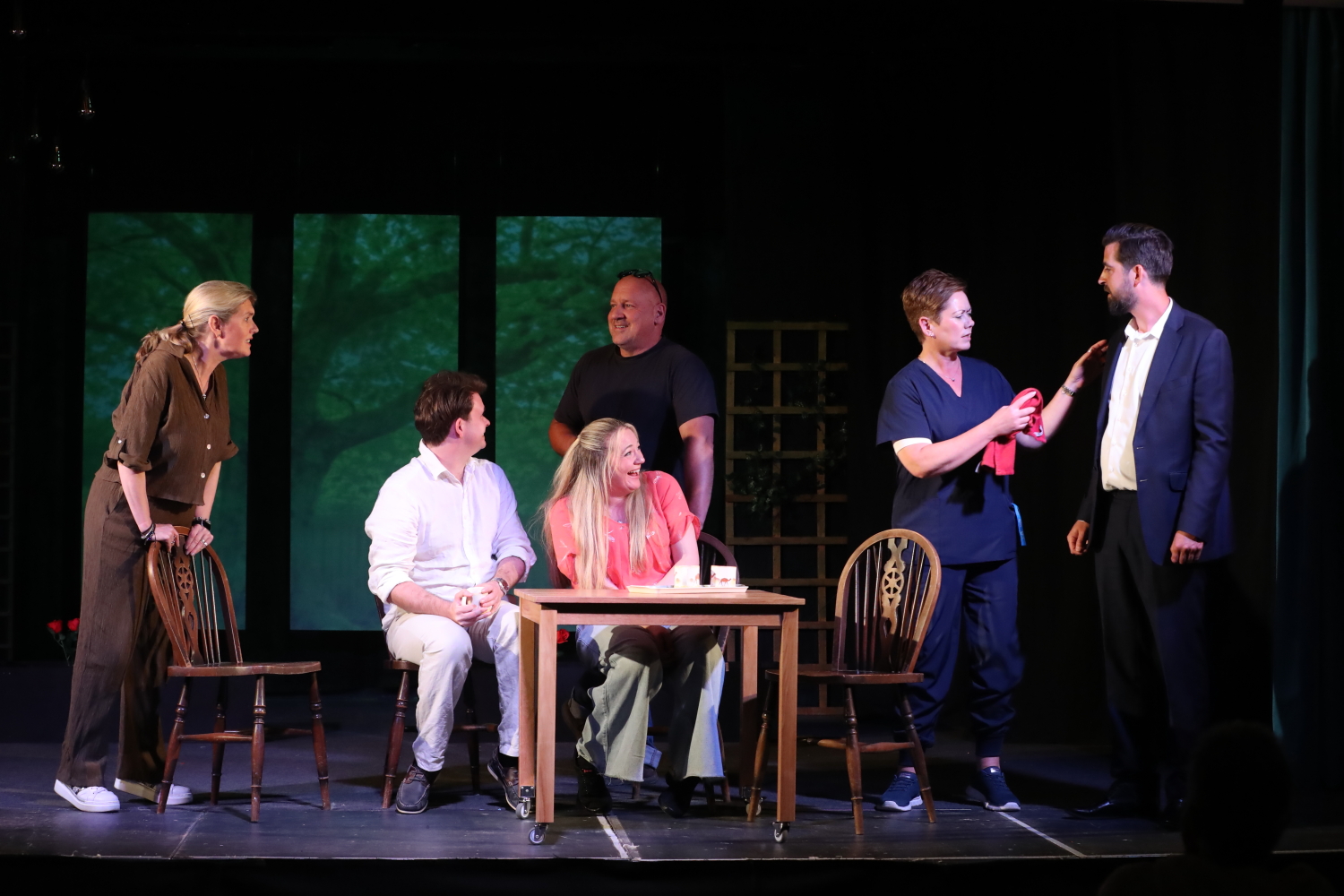
The simple set consisted of a projection of a large old tree, against a garden fence, in front of which were Dad’s pride and joy, his treasured roses, set in boxed beds. Left and right of the tree were two rose trellises. To the right of the stage was a small table on wheels that could be cleverly and quickly rolled into place when needed, which wasn’t very often, in fact. Four chairs and one cube were the only other props. Most of the dialogue, or the many fine monologues, occurred with people standing.
Lighting was very sensitive and effective. The production opened with Leonard Cohen’s song ‘Famous Blue Raincoat’. This appeared throughout the play, it had evidently been a very important song in Fran’s life. Sound effects were good, with the bustle of Berlin’s Main Station, and the sounds of the garden.
The production opened with Bob in his dressing gown, the phone ringing in the middle of the night. Which of the four children could it be? What disaster has befallen them? How will I tell their Mum?
We switch to the bustle of Berlin Main Station. A breezy Rosie had been on a gap year in Europe, and marvelled at all the wonderful cities she had enjoyed. Now though, after only three months, she’s headed home. Home for comfort. She’d been robbed by the boy she’d just fallen for. Into her, what, 4 minute soliloquy, Rosie packed all the highs and lows the single traveller gap year student experiences, including the awkwardness; the loneliness; the feeling you don’t belong; the confusion; and of course the homesickness, yet feeling you can’t give in. And her disappointment that yes, now she must.
Already at this point, we realised this was a damn good play. Maxine Fox’s portrayal of Rosie, the strength with which she held the audience in this first long soliloquy, was marvellous. What got me personally was the detail that this horrid lover had not only stolen a large amount of cash, her iPad and other valuables, but also her favourite scarf. This was fine writing indeed.
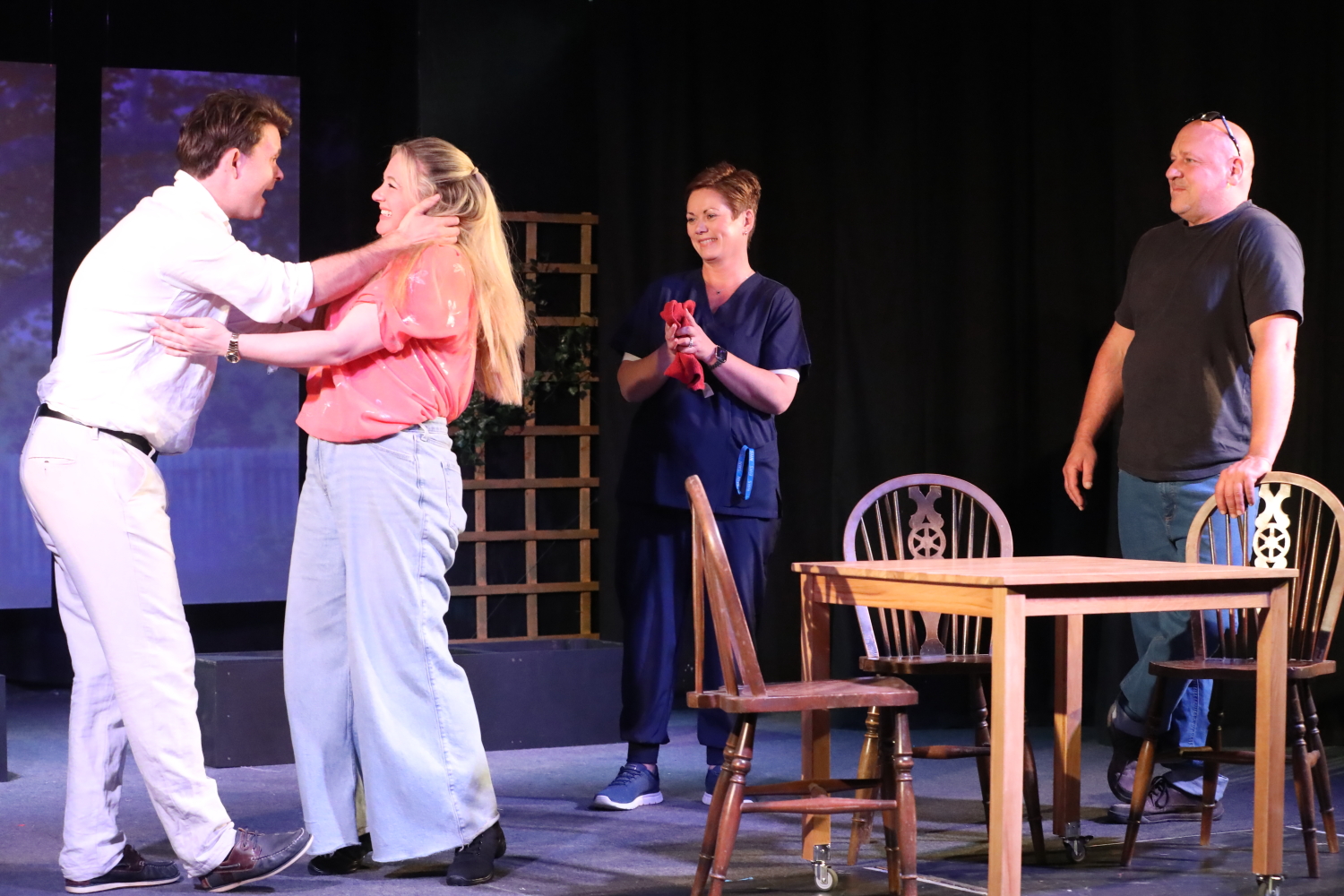
Back in the garden, Dad’s using his new leaf-blower, Mum is in her nurse’s uniform and just off to work, giving Bob his instructions about picking up the grandchildren. He’s relaxed, she’s not stressed, just organised. Rosie arrives, out of the blue, to their delight. Yet Mum knows something’s wrong. And so the scene is set. Gradually, one by one, the children breeze in to greet Rosie. And gradually throughout the first half, this comfortable, perfect world starts to come apart.
Pip, the elder daughter, working mother of two, provides the next upset, announcing she wants to leave her kind, supportive husband and her kids, to take a job in Vancouver. Mum Fran suspects there’s another man – mums can often read their children’s minds. Pip releases all her deep-seated suppressed anger towards her mum, her jealousy, her feeling of being blamed and rejected. Once again, such a powerful performance from Katie Kinnes, we ached for her. This was the thing with this cast, they inhabited their roles 100%, they brought out all the nuances and little details of the script, we were absolutely gripped. There were so many great sentences, great points, in here, I wanted to take many more notes, yet I knew I would miss so much if I was distracted by putting pen to paper. One thing I do remember from Pip was her asking, now that her own daughters were starting to grow up, whether mums often subconsciously put their daughters down out of some kind of weird fear of being outshone. Gosh, this was strong stuff.
The scene where Fran received a long letter from Vancouver, personally addressed to her, and reads it alone in the garden, deep in thought, with Dad excluded, tending his roses at the back of the garden, was astonishing. Such a well-judged performance from Jude Pitcher as Fran, portraying her as the complex, thoughtful woman, not just the strong and capable mum and nurse. Excellent! This was theatre at its finest, I doubt you could get this atmosphere on a screen, you could have cut it with a knife.
Mark, the older of the two sons, was next to shatter the peace of this garden. He revealed that he wanted to change his gender, and move away to Manchester to do this. This was so hard to watch, made more so by Ben Hilton’s brilliantly sensitive performance as Mark. There was anger, rage, sadness, uncertainty. Bob and Fran didn’t know how to react, which parents would? Fran tried to be the strong one, but didn’t really manage to be.
The scene between Mark and Rosie, as he was packing his case with her helping him, was lovely. ‘I’m worried that……’ Rosie kept saying, as she thought of other problems he might face, about 8 times. ‘You have to stop loving us so much. You have to walk away.’ Mark told her. ‘Or then stay, and be the one THEY want.’ So powerful, this script. So full of love, this scene.
After the interval, Ben, the younger son, bit of a mummy’s boy, arrived in a state of great agitation. ‘What are you on?’ Fran asked immediately. It turned out the flash Mercedes he’d so proudly shown off in the first half (much to Dad’s disgust – ‘Ben, we’re not like that’) was purchased from funds he had misappropriated in his job as a banker. Sam McCone excelled as Ben, his panic, his despair, a child coming home to have everything put right. Another great scene.
And all the while, as this Annus Horribilis progressed, Mum and Dad, Fran and Bob, discovered things about themselves and their own marriage that surprised them, uncertainties, fragilities, weaknesses and strengths, and of course aspects of love.
One performance that cannot be underestimated was that of Paul Elliott as Bob. My companion and I were fascinated by this character, he was so layered, so complex, Paul Elliott absolutely nailed the often oh so difficult role of the husband and father in late middle age. Strong, supportive he wanted to be, yet found himself overwhelmed; sometimes excluded; deeply hurt (by Fran); exasperated and totally enraged by Ben; bewildered and devastated about Mark. Paul Elliott played this just right, absolutely perfectly, not overdoing it, understated almost, yet so terribly affecting.
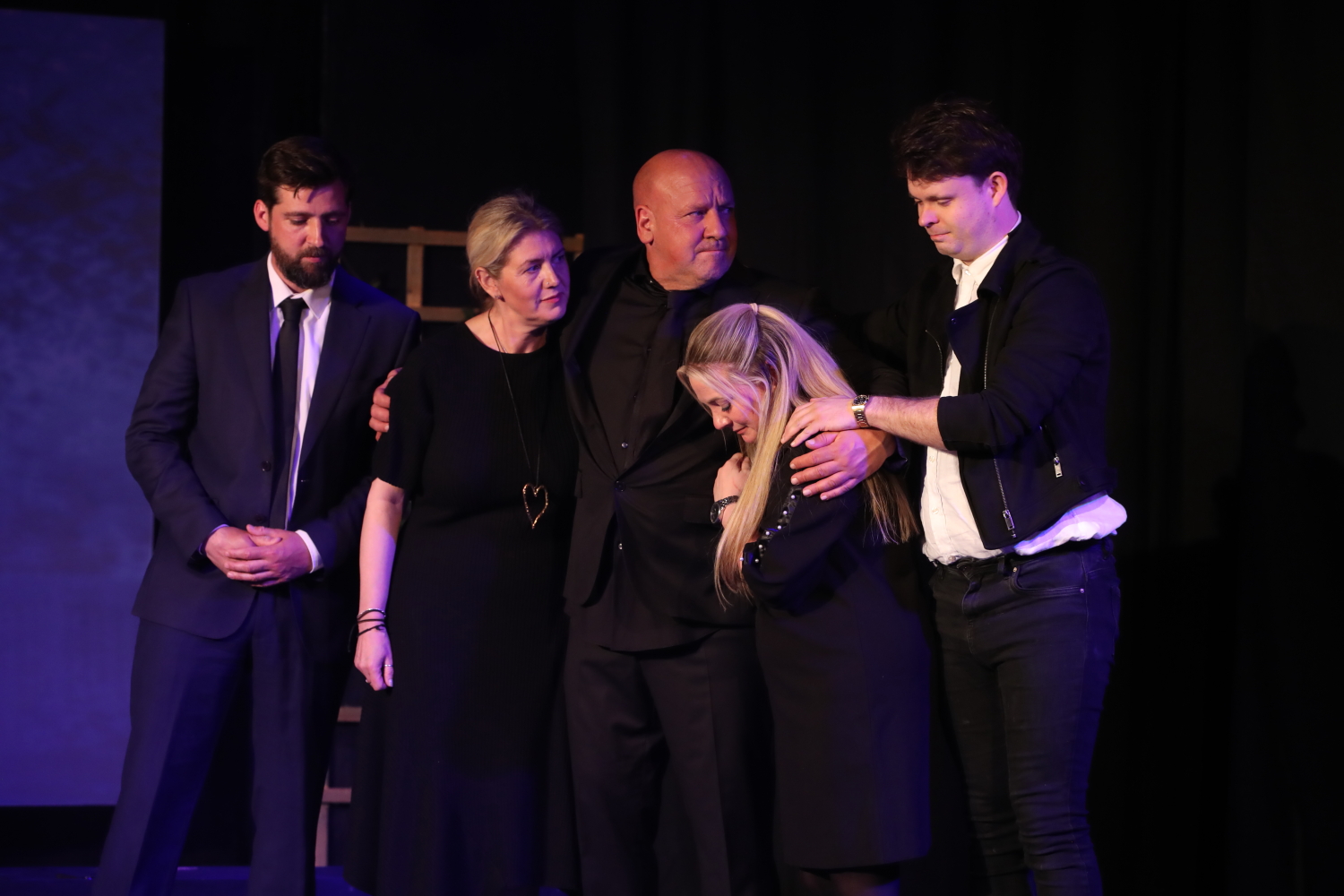
The harrowing ending, the nighttime phone call, Bob in his dressing gown again, recalled the start of the play. Rosie again, ending once more with her list of ‘Things I Know to be True’. Such a finely crafted piece.
Director Ted Horton provided us with the perfect cast. His fine direction led them and us on this amazing journey through this year.
And the roses! Bob’s roses, his pride and joy. Fran had wanted a change, something different after all the years of these same plants. In the anger of his grief, he ripped them all out.
This production was a tour de force. We could not have seen better in the West End. The audience reaction was tremendous, a very long standing ovation. Thank you so much, Peaslake Players, for enriching our lives in this way. Good theatre stays with you. This will live in my memory for many a year.
 |
 |
 |
© NODA CIO. All rights reserved.