
8th August 2026
Oh Vicar, What a Lovely Pair
Lancing Repertory Players, Lancing Little Theatre
 Show Reports
It's a Wonderful Life
Show Reports
It's a Wonderful Life
It would seem that, for many people, the film of ‘It’s a Wonderful Life’ has become a well-visited Christmas tradition, with families viewing it year after year. Personally I had barely heard of it, let alone seen it, so I approached this Ewhurst production with completely fresh eyes. First released in 1946, the film didn’t start out as a great success. Only when it became possible for folk to watch it on TV did it grow to become a regular part of the Christmas season for so many. The year of its release is significant, as the story deals with George Baily, a man who was unable to serve in the military in WW2 for medical reasons, yet had a decorated war hero for a younger brother. He became very depressed about his humdrum existence, and contemplated ending it all. A ‘trainee’ angel was sent from heaven to protect him from himself, and succeeded in pointing out to him that all his small, or large, acts of kindness to others or courage throughout his life, meant that his life had a value and was worth living. Ordinary lives matter, kindness counts, none of us truly knows the impact we have on others. As the Ikea advert says: ‘The wonderful everyday’ – that’s what real life is all about, and we need to appreciate it, every minute.
The well-designed programme made a very interesting read, with a page on interesting anecdotes from the making of the film; another on transforming the film into a play; some rehearsal photos and interesting directors’ and cast profiles.
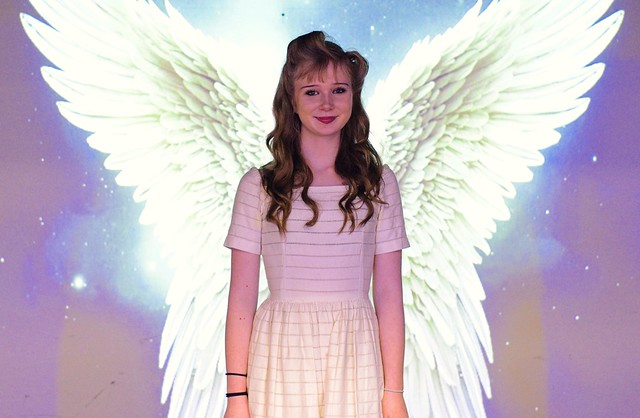
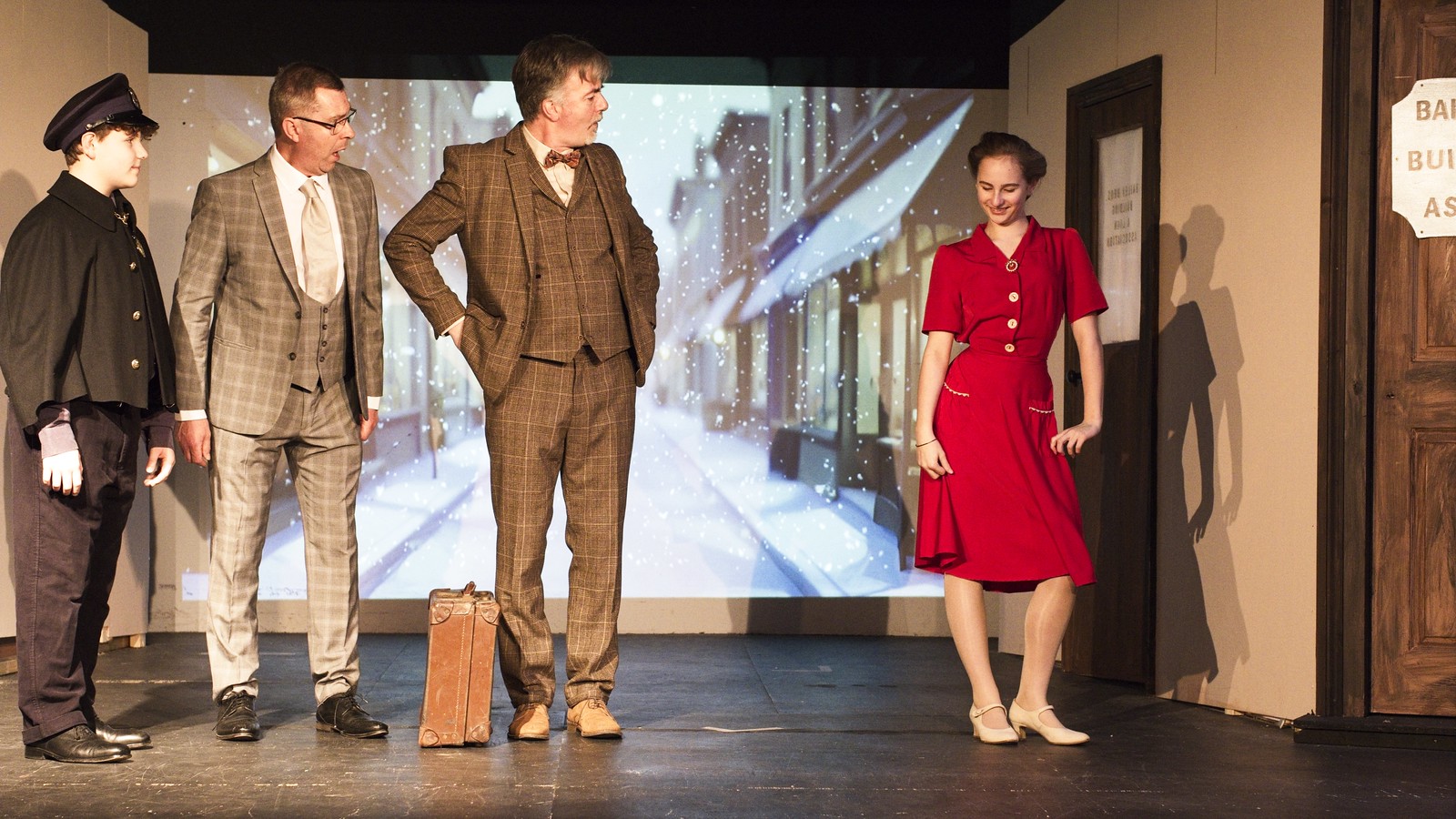
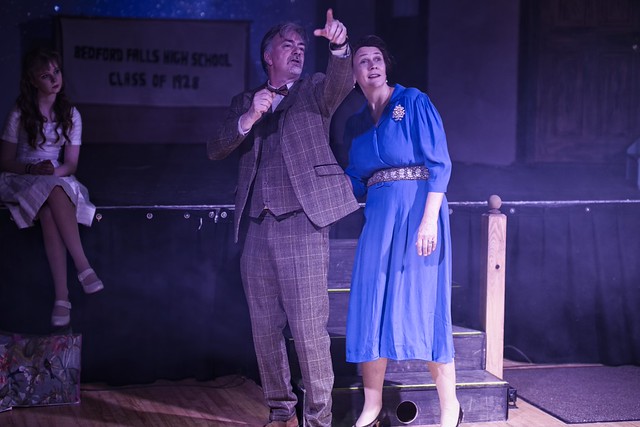
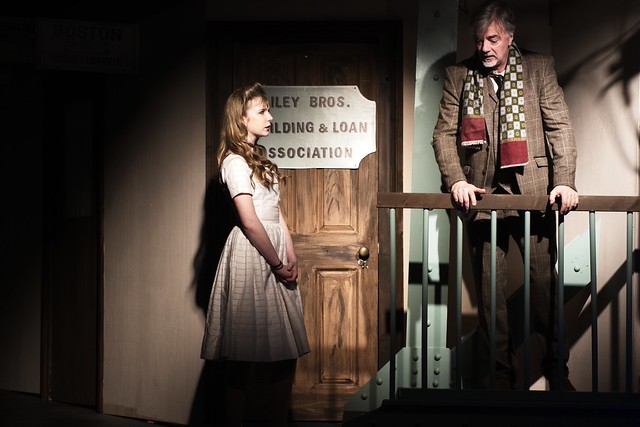
As we took our seats, we were greeted by the sight of two beautiful angel wings projected onto the backdrop, against a stunning blue sky. This backdrop changed as we went through the scenes, becoming various streets in the town of Bedford Falls, in snowstorms or in sunny weather. It became a party backdrop for the Prom scene, and various others throughout the play. There were two doors either side of the set, with changing signs – one for George’s firm, one for Mr Gower’s Drugstore, for Martini’s bar, and so on. In the corridor between them were cleverly retractable signs denoting various shops or businesses on the main street eg Emporium, Antiques, Meat Market, Boston Suitcase and Luggage Company and so on. These changing signs denoted the passing of the years, the changing town scene. Simple but extremely effective. A reception desk was wheeled on to represent the inside of Bailey’s Building and Loan Association. A payphone played an important role to the front of the stage, as news came through, often with news of George’s brother Harry, or with calls from Harry himself, or from his old friend Sam. Also very effective. There was a lovely winter scene in a forest with children playing snowballs, and with sledges and iceskates. To the right of the stage was the fateful bridge, where George quite often contemplated ending it all.
Costumes were chosen with care to represent the period, and there were some fun costumes for the earlier Prom scene, as people showed their skills at the Charleston and other dances current in George and Harry’s younger years.
Lighting and sound were effective throughout. Sometimes it was a little difficult to hear what the younger cast members were saying, so maybe voice projection could be worked on a little.
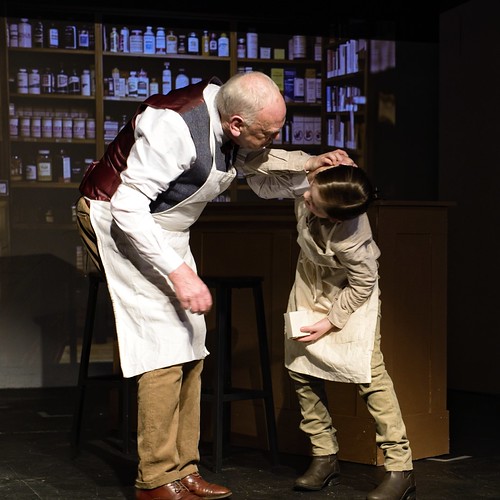
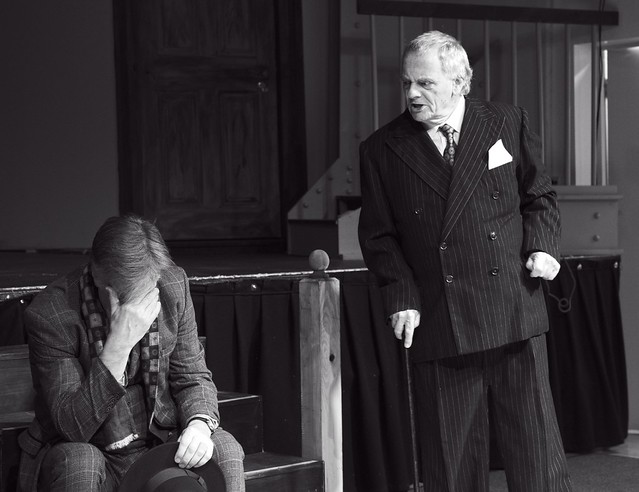
Directors Ben Aveyard and Nicki Payne had put together a very good cast. Grace Tosh, as trainee angel Clarissa Oddbody, played her role very well, she was charming yet unsure of herself in the task allotted to her of saving George from himself. Steph Kay, as Gloria, in her gold hair cover, made a super guide for the trainee, when she was unsure, Gloria gave her courage. Peter Bradley made a fine Mr Potter, the villain of the piece, a tough real estate investor, who haunted George’s business life. George’s childhood friend Sam, a happy-go-lucky, carefree fellow, was a fun part for David Barraclough, though his breezing through life was somewhat irritating for George. George’s intervention in the life of Mr Gower, in whose drugstore he worked as a teenager, where he prevented a drunken Mr Gower from prescribing a fatal dose of the wrong medication to one of his clients, was well-presented with a good performance from Mike Humphries as Mr Gower.
George’s wife Mary was played very competently and sympathetically, both as a young lady and as a very concerned wife and mother by Cath Van’t Riet, it would have been nice to see more of her. Wendy Davies was great in the role of George’s Aunt Dilly, proving yet again what a great character actor she is, and adding just the right amount of light relief. George’s brother Harry was a good part for CJ Bartholomew, he made clear the development of Harry from young student, to husband, to much admired local war hero. Poor George! Life had dealt him a mean hand. Various other parts were played by a lively group of young actors, fair praise to them, they were a great team, with many changing roles to master.
And now I come to George. Simon Fraser was fabulous as George, the man who life seemed to kick in the teeth. So many chances lost, never able to realise his youthful dreams of studying, of travel, of adventure – dreams his younger brother, who he adored, whose life he had saved as a kid, was able to realise. The stressed, somewhat hapless businessman, forced to take over the soon outdated family firm on the untimely death of his father, always plagued by the interventions of the unpleasant Mr Potter. Snapping at his children and his loving wife. Seeing no way out of his misery. A huge role, George Bailey is rarely off the stage. Simon Fraser brought out all his dilemmas, frustrations, weaknesses, faults and anger (and yet also the loveable side of his nature, for he was much loved by his family and friends and many in the community) vividly to life. George became a very real person we could all identify with, or we could all find people we knew who were like him. An admirable performance this.
A lovely touch at the end of the performance was as Clarissa Oddbody, having proved to George his worth, and saved his life, and thus having gained her wings, stood at the back of the stage framed by those huge wings. Stunning!
A huge undertaking, well done Ben and Nicki, and the whole team!
 |
 |
 |
 |
 |
 |
© NODA CIO. All rights reserved.